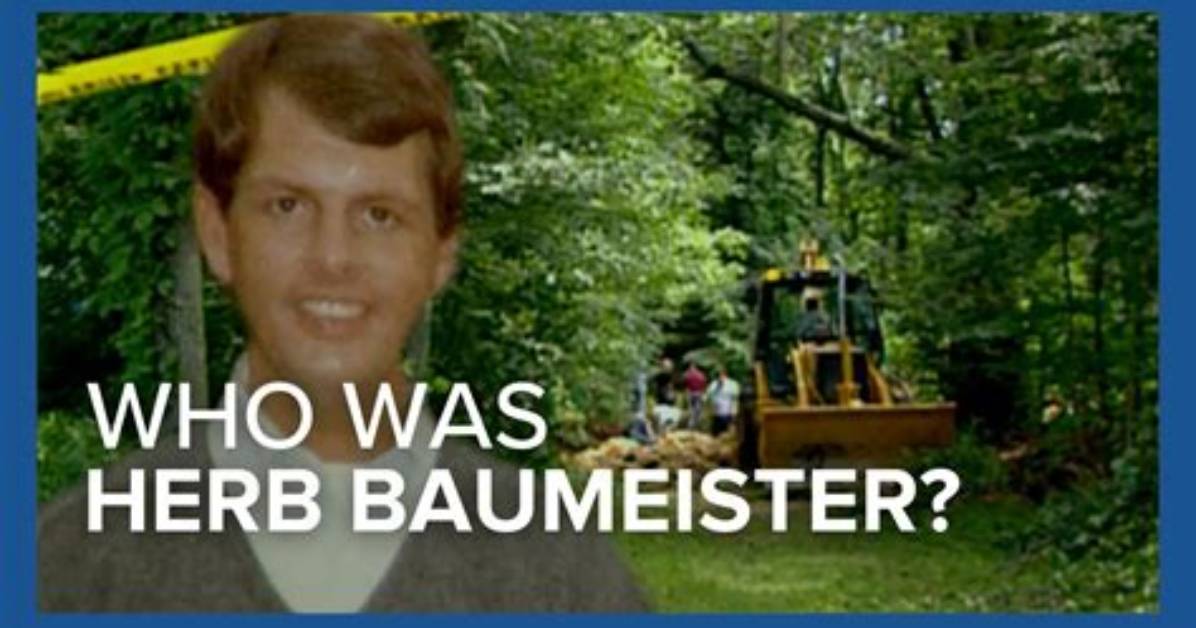
By the early 1990s, investigators with the Marion County Sheriff’s Department and the Indianapolis Police Department began investigating the disappearances of gay men of similar age, height, and weight in the Indianapolis area. In 1992, they were contacted by a man named Tony Harris claiming that a gay bar patron calling himself “Brian Smart” had killed a friend of his, and had attempted to kill him with a pool hose during an erotic asphyxiation session. Harris eventually happened to see this same man again in August 1995, following him and noting a license plate number. From this data, police identified “Brian Smart” as Herb Baumeister.
Investigators approached Baumeister, told him he was a suspect in the disappearances, and asked to search his house. Both Baumeister and his wife, Julie, refused to allow a search of their house. By June 1996, however, Julie had become sufficiently frightened by her husband’s mood swings and erratic behavior that, after filing for divorce, she consented to a search. The search of the 18-acre (73,000 m) estate, Fox Hollow Farm, was conducted while Baumeister was on vacation; it turned up the remains of eleven men, eight of whom were identified.
With a warrant out for his arrest, Baumeister fled to Ontario, where he committed suicide at Pinery Provincial Park, on Lake Huron, by shooting himself in the head. In his suicide note, he described his failing marriage and business as his reason for killing himself. He did not confess to the murders of the men found in his backyard.
Baumeister would posthumously be suspected of killing nine other men, the bodies of whom were found in rural areas along the corridor of Interstate 70 between Indianapolis and Columbus, Ohio during the early to mid 1980s. One eyewitness identified Baumeister as the man seen leaving a bar in 1983 with Michael Riley, who was later found dead; like the other victims, Riley was strangled to death and deposited nude or semi-nude in a river.

