Technique
Rachmaninoff ranked among the finest pianists of his time, along with Leopold Godowsky, Ignaz Friedman, Moriz Rosenthal, Josef Lhévinne, and Josef Hofmann, and he was famed for possessing a clean and virtuosic technique. His playing was marked by precision, rhythmic drive, notable use of staccato and the ability to maintain clarity when playing works with complex textures. Rachmaninoff applied these qualities in music by Chopin, including the B-flat minor Piano Sonata. Rachmaninoff’s repertoire, excepting his own works, consisted mainly of standard 19th Century virtuoso works plus music by Bach, Beethoven, Borodin, Debussy, Grieg, Liszt, Mendelssohn, Mozart, Schubert, Schumann and Tchaikovsky.
Rachmaninoff possessed extremely large hands, with which he could easily maneuver through the most complex chordal configurations. His left hand technique was unusually powerful. His playing was marked by definition—where other pianists’ playing became blurry-sounding from overuse of the pedal or deficiencies in finger technique, Rachmaninoff’s textures were always crystal clear. Only Josef Hofmann and Josef Lhévinne shared this kind of clarity with him. All three men had Anton Rubinstein as a model for this kind of playing—Hofmann as a student of Rubinstein’s, Rachmaninoff from hearing his famous series of historical recitals in Moscow while studying with Zverev, and Lhevinne from hearing and playing with him.
The two pieces Rachmaninoff singled out for praise from Rubinstein’s concerts became cornerstones for his own recital programs. The compositions were Beethoven’s Appassionata and Chopin’s Funeral March Sonata. He may have based his interpretation of the Chopin sonata on Rubinstein’s. Rachmaninoff biographer Barrie Martyn points out similarities between written accounts of Rubinstein’s interpretation and Rachmaninoff’s audio recording of the work.
As part of his daily warm-up exercises, Rachmaninoff would play the technically difficult Étude in A-flat, Op. 1, No. 2, attributed to Paul de Schlözer.
Tone
From those barely moving fingers came an unforced, bronzelike sonority and an accuracy bordering on infallibility. Arthur Rubinstein wrote:
He had the secret of the golden, living tone which comes from the heart … I was always under the spell of his glorious and inimitable tone which could make me forget my uneasiness about his too rapidly fleeting fingers and his exaggerated rubatos. There was always the irresistible sensuous charm, not unlike Kreisler’s.
Coupled to this tone was a vocal quality not unlike that attributed to Chopin’s playing. With Rachmaninoff’s extensive operatic experience, he was a great admirer of fine singing. As his records demonstrate, he possessed a tremendous ability to make a musical line sing, no matter how long the notes or how complex the supporting texture, with most of his interpretations taking on a narrative quality. With the stories he told at the keyboard came multiple voices—a polyphonic dialogue, not the least in terms of dynamics. His 1940 recording of his transcription of the song “Daisies” captures this quality extremely well. On the recording, separate musical strands enter as if from various human voices in eloquent conversation. This ability came from an exceptional independence of fingers and hands.
Memory
Rachmaninoff also possessed an uncanny memory—one that would help put him in good stead when he had to learn the standard piano repertoire as a 45-year-old exile. He could hear a piece of music, even a symphony, then play it back the next day, the next year, or a decade after that. Siloti would give him a long and demanding piece to learn, such as Brahms’ Variations and Fugue on a Theme by Handel. Two days later Rachmaninoff would play it “with complete artistic finish.” Alexander Goldenweiser said, “Whatever composition was ever mentioned—piano, orchestral, operatic, or other—by a Classical or contemporary composer, if Rachmaninoff had at any time heard it, and most of all if he liked it, he played it as though it were a work he had studied thoroughly.”
Interpretations
Regardless of the music, Rachmaninoff always planned his performances carefully. He based his interpretations on the theory that each piece of music has a “culminating point.” Regardless of where that point was or at which dynamic within that piece, the performer had to know how to approach it with absolute calculation and precision; otherwise, the whole construction of the piece could crumble and the piece could become disjointed. This was a practice he learned from Russian bass Feodor Chaliapin, a staunch friend. Paradoxically, Rachmaninoff often sounded like he was improvising, though he actually was not. While his interpretations were mosaics of tiny details, when those mosaics came together in performance, they might, according to the tempo of the piece being played, fly past at great speed, giving the impression of instant thought.
One advantage Rachmaninoff had in this building process over most of his contemporaries was in approaching the pieces he played from the perspective of a composer rather than that of an interpreter. He believed “interpretation demands something of the creative instinct. If you are a composer, you have an affinity with other composers. You can make contact with their imaginations, knowing something of their problems and their ideals. You can give their works color. That is the most important thing for me in my interpretations, color. So you make music live. Without color it is dead.” Nevertheless, Rachmaninoff also possessed a far better sense of structure than many of his contemporaries, such as Hofmann, or the majority of pianists from the previous generation, judging from their respective recordings.
A recording which showcases Rachmaninoff’s approach is the Liszt Second Polonaise, recorded in 1925. Percy Grainger, who had been influenced by the composer and Liszt specialist Ferruccio Busoni, had himself recorded the same piece a few years earlier. Rachmaninoff’s performance is far more taut and concentrated than Grainger’s. The Russian’s drive and monumental conception bear a considerable difference to the Australian’s more delicate perceptions. Grainger’s textures are elaborate. Rachmaninoff shows the filigree as essential to the work’s structure, not simply decorative.
Speculations about Marfan syndrome and acromegaly
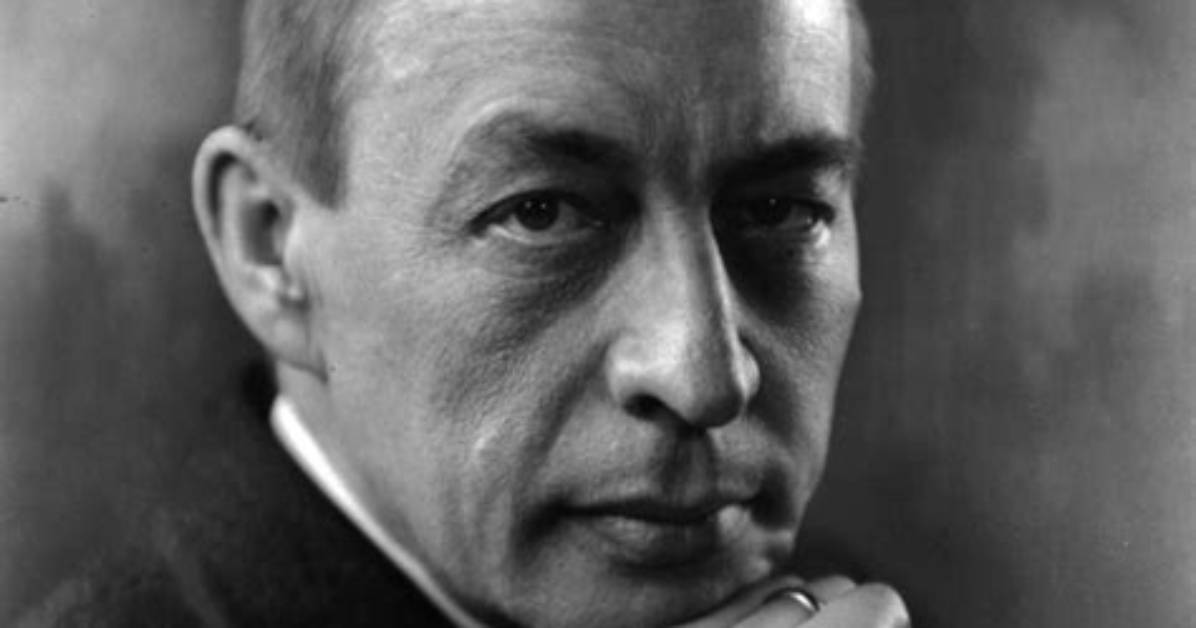
Along with his musical gifts, Rachmaninoff possessed physical gifts that may have placed him in good stead as a pianist. These gifts included exceptional height and extremely large hands with a gigantic finger stretch (he could play the chord C E♭ G C G with his left hand). This and Rachmaninoff’s slender frame, long limbs, narrow head, prominent ears, and thin nose suggest that he may have had Marfan syndrome, a hereditary disorder of the connective tissue. This syndrome would have accounted for several minor ailments he suffered all his life, including back pain, arthritis, eye strain, and bruising of the fingertips, although others have pointed out that this was more likely because he was playing the piano all day long. This Marfan speculation was proposed by Dr. D. A. B. Young (formerly principal scientist of the Wellcome Foundation) in a 1986 British Medical Journal article. Twenty years later, an article in the Journal of the Royal Society of Medicine, by Ramachandran and Aronson differed greatly from Young’s speculation:
The size of [Rachmaninov’s] hands may have been a manifestation of Marfan’s syndrome, their size and slenderness typical of arachnodactyly. However, Rachmaninov did not clearly exhibit any of the other clinical characteristics typical of Marfan’s, such as scoliosis, pectus excavatum, and eye or cardiac complications. Nor did he express any of the clinical effects of a Marfan-related syndrome, such as Beal’s syndrome (congenital contractural arachnodactyly), Ehlers-Danlos syndrome, homocystinuria, Stickler syndrome, or Sphrintzen-Goldberg syndrome. There is no indication that his immediate family had similar hand spans, ruling out familial arachnodactyly. Rachmaninov did not display any signs of digital clubbing or any obvious hypertrophic skin changes associated with pachydermoperiostitis.
Acromegaly is an alternative diagnosis. From photographs of Rachmaninov in the 1920s and his portrait by Konstantin Somov in 1925 (Figure 1), at a time when he was recording his four piano concerti, the coarse facial features of acromegaly are not immediately apparent. However, a case can be made from later photographs…
During a heavy concert schedule in Russia in 1912, he interrupted his schedule because of stiffness in his hands. This may have been due to overuse, although carpal tunnel syndrome or simply swelling and puffiness of the hands associated with acromegaly may have been the cause. In 1942, Rachmaninov made a final revision of his troublesome Fourth Concerto but composed no more new music. A rapidly progressing melanoma forced him to break off his 1942–1943 concert tour after a recital in Knoxville, Tennessee. A little over five weeks later he died in the house he had bought the year before on Elm Drive in Beverly Hills. Melanoma is associated with acromegaly and may have been a final clue to Rachmaninov’s diagnosis.
But then again, perhaps he just had big hands.
Contrary to rumors of “six and a half feet,” Rachmaninoff’s physical height is documented in repeated (10 November 1918 and 30 October 1924) U.S. Immigration manifests at Ellis Island as 6′-1″. However, conductor Eugene Ormandy (who teamed with Rachmaninoff in many piano and orchestra performances) recalled in 1979: “He [Rachmaninoff] was about six feet-three. I am five feet-five and a half…” Therefore, Rachmaninoff’s height would also not be considered a physical deformity or abnormality.

