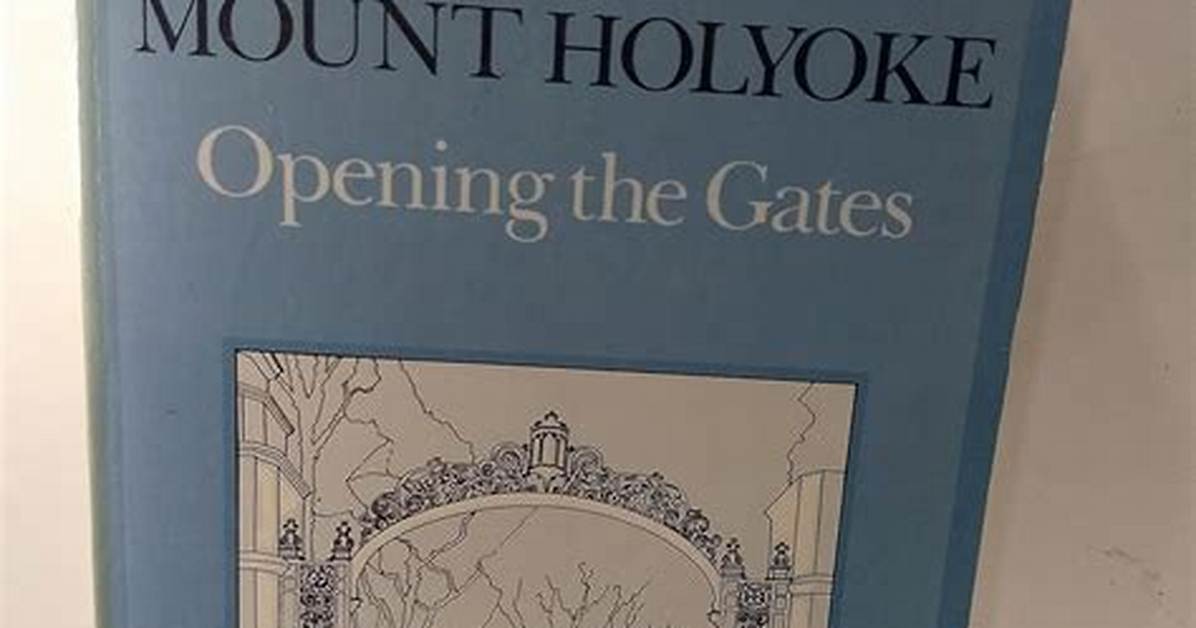
Mount Holyoke
During these early years, Lyon gradually developed its vision for the Mount Holyoke Female Seminary, which in many respects would resemble Grant’s schools but, Lyon hoped, would draw its students from a broader socio-economic range. The college was unique in being founded by humble-minded people and serving their daughters rather than the rich’s children. She was particularly influenced by Reverend Joseph Emerson, whose Female Education Discourse (1822) advocated that women should be trained as teachers instead of “pleasing the other sex.”
Mount Holyoke opened in 1837: the seminary was ready for “the reception of scholars on November 8, 1837.” Lyon sought to maintain high academic standards: she set rigorous entrance examinations and admitted “young women of an adult age and mature character.”In line with her social vision, she limited the tuition to $60/year, about one-third the tuition that Grant charged at Ipswich Female Seminary, which was central to her mission of “appeal[ing] to the intelligence of all classes.”
Lyon, an early believer in the importance of daily exercise for women, required her students to walk one mile (1.6 km) after breakfast. During the cold and snowy winters of New England, she reduced the requirement to 45 minutes. Calisthenics, a form of exercise, was taught by teachers in unheated halls until a gymnasium storage area was cleared.
Lyon required students to perform domestic tasks— an early version of work/study — to keep costs low. Preparing meals and washing floors and windows included these tasks. He was tasked with cleaning knives by Emily Dickinson, who attended the seminary in 1847. Although the policies of Lyon were sometimes controversial, the seminar quickly attracted its 200-member target student body.
Lyon anticipated a change in the role of women and equipped her pupils with an education that was comprehensive, rigorous, and innovative, with particular emphasis on the sciences. She required:
seven courses in the sciences and mathematics for graduation, a requirement unheard of at other female seminaries. She introduced women to “a new and unusual way” to learn science—laboratory experiments which they performed themselves. She organized field trips on which students collected rocks, plants, and specimens for lab work, and inspected geological formations and recently discovered dinosaur tracks.
Religion
Conforti (1993) examines Lyon’s central religious importance. Under the influence of her teacher Reverend Joseph Emerson, she was raised a Baptist but converted to a Congregationalist. Lyon preached revivals at Mount Holyoke, spoke elsewhere, and was a member of New England’s New Divinity clergy fellowship, although not a minister. She played a major role in reviving Jonathan Edwards’s thinking, whose works were then read more often than in his day. Her ideas of self-restraint, self-denial, and disinterested benevolence attracted her.

